After Hours · poster system
Late nights, two inks.
A poster system for a museum's late-night programme. Every event gets a two-ink risograph poster from the same rules, along with the drum masters to print it, a motion version for the foyer screens and a listing people can add to their calendar.
- Role
- Art direction, print design, build
- Platform
- Web studio with print and video output
- Built with
- JavaScript, Canvas, MediaRecorder
- Status
- Concept study · working studio


01 / The brief
Eight very different nights, one unmistakable look.
A late programme mixes talks, films, workshops and club nights. Each needs its own poster, made quickly, cheaply and by a small team. The posters have to feel different from one another and still read instantly as After Hours.
A club night and a supper talk shouldn't look alike, but a season of one-off designs stops looking like a series.
Risograph printing is affordable and looks great, but it needs one master per ink, not a colour file.
The same poster has to work on a wall, on the foyer screens and in the listings, and get people to turn up.
A concept study, honestly framed. After Hours, the Halden Exchange, every event and every name are fictional, and the copy is placeholder writing. There was no client and no formal research. The ink colours are screen approximations of common riso inks, and nothing has been printed on a real risograph yet.
02 / Make one
Type a night. Get its poster.
This is the studio's own poster engine. Change the title, the hours or the inks and the poster redraws: type fitted to its zone, the night's hours on the dial, the real moon phase in the strip, and the darker ink always carrying the small type.
Layout
Drum 1
Drum 2
Try a long title, a club night from 23:00 to 05:00, or two light inks, and watch the rules respond.
03 / The system
The middle changes. Nothing else does.
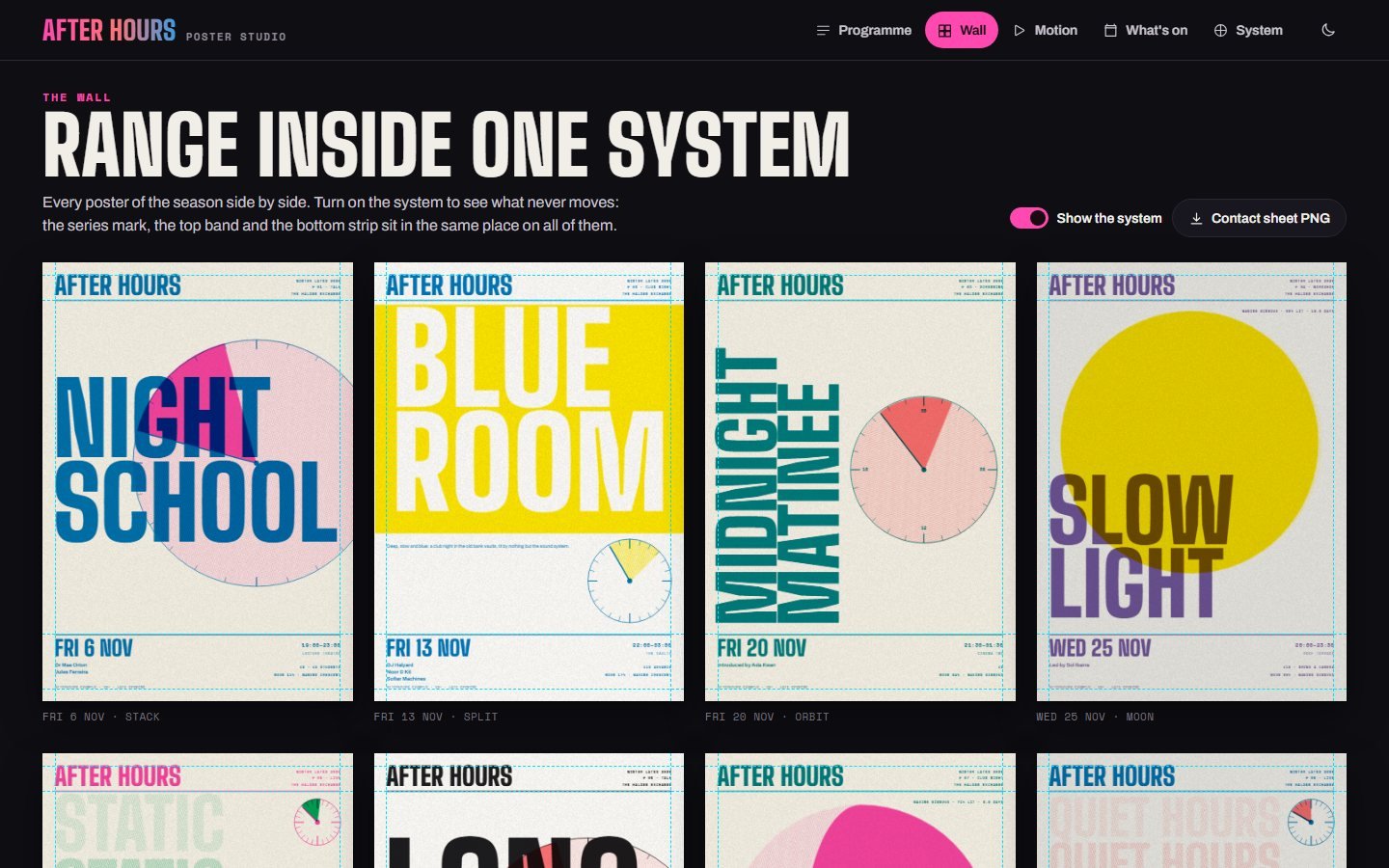
Every poster shares one hierarchy: the series mark and season across the top, details in a strip along the bottom, and the title in the zone between. Five layouts change only that middle zone. With the system's guides on, the whole season lines up.
- 01
Two inks, never three. The overprint is the third colour.
- 02
Small type in the darker ink, picked by luminance, with a 3:1 minimum against the paper.
- 03
The hours are always there. A 24-hour dial shows the night, so a supper talk and a club night look different at a glance.
- 04
So is the moon. Its real phase on the night is printed in the strip, and the Moon layout draws it.
- 05
Titles fill their zone, fitted to the space, with a warning below 30 mm.
Eight inks, twenty-eight overprints
What each pair makes where they cross, computed live from the same code (a multiply).
04 / Made for the riso
One poster, two masters.
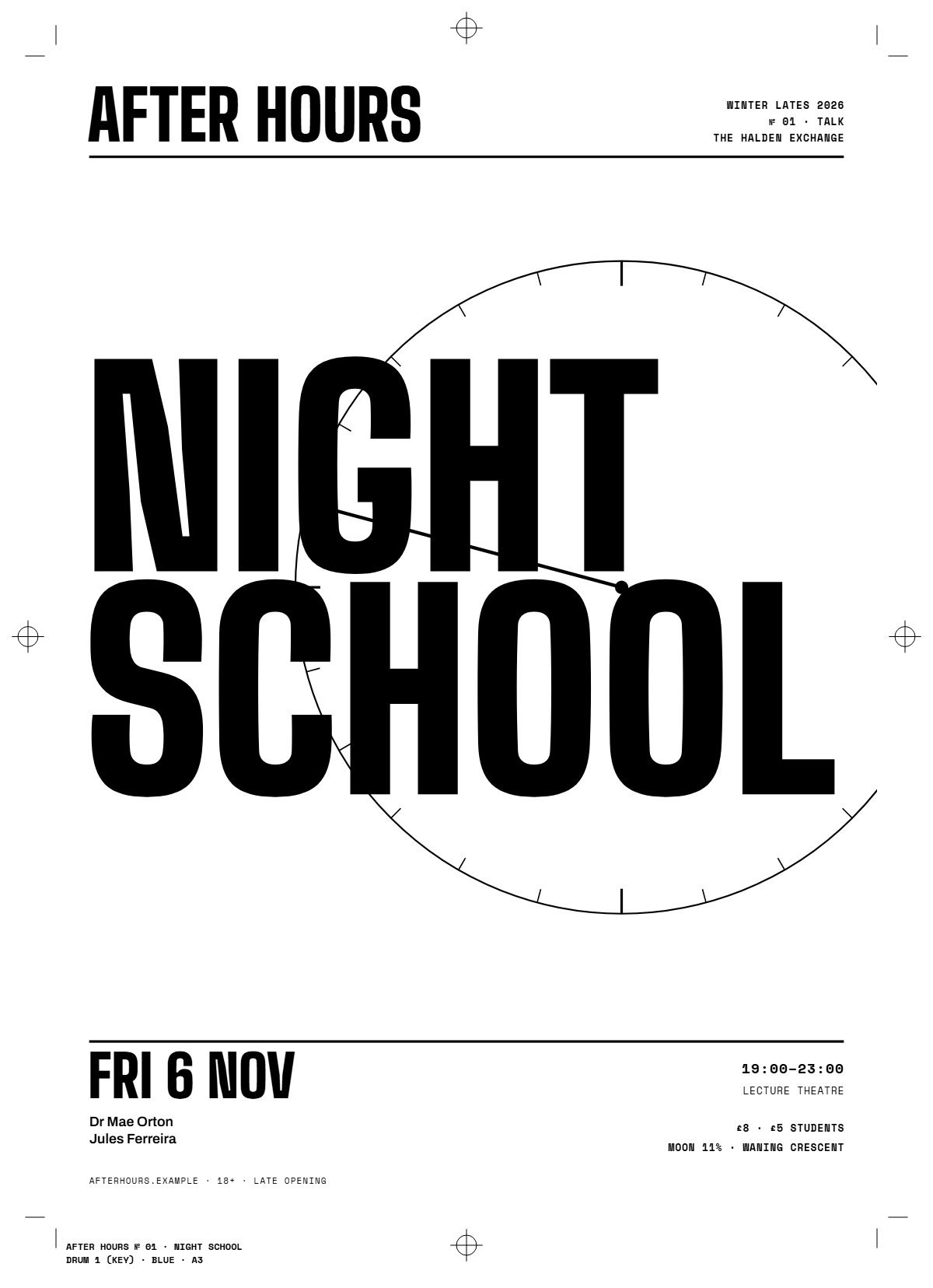
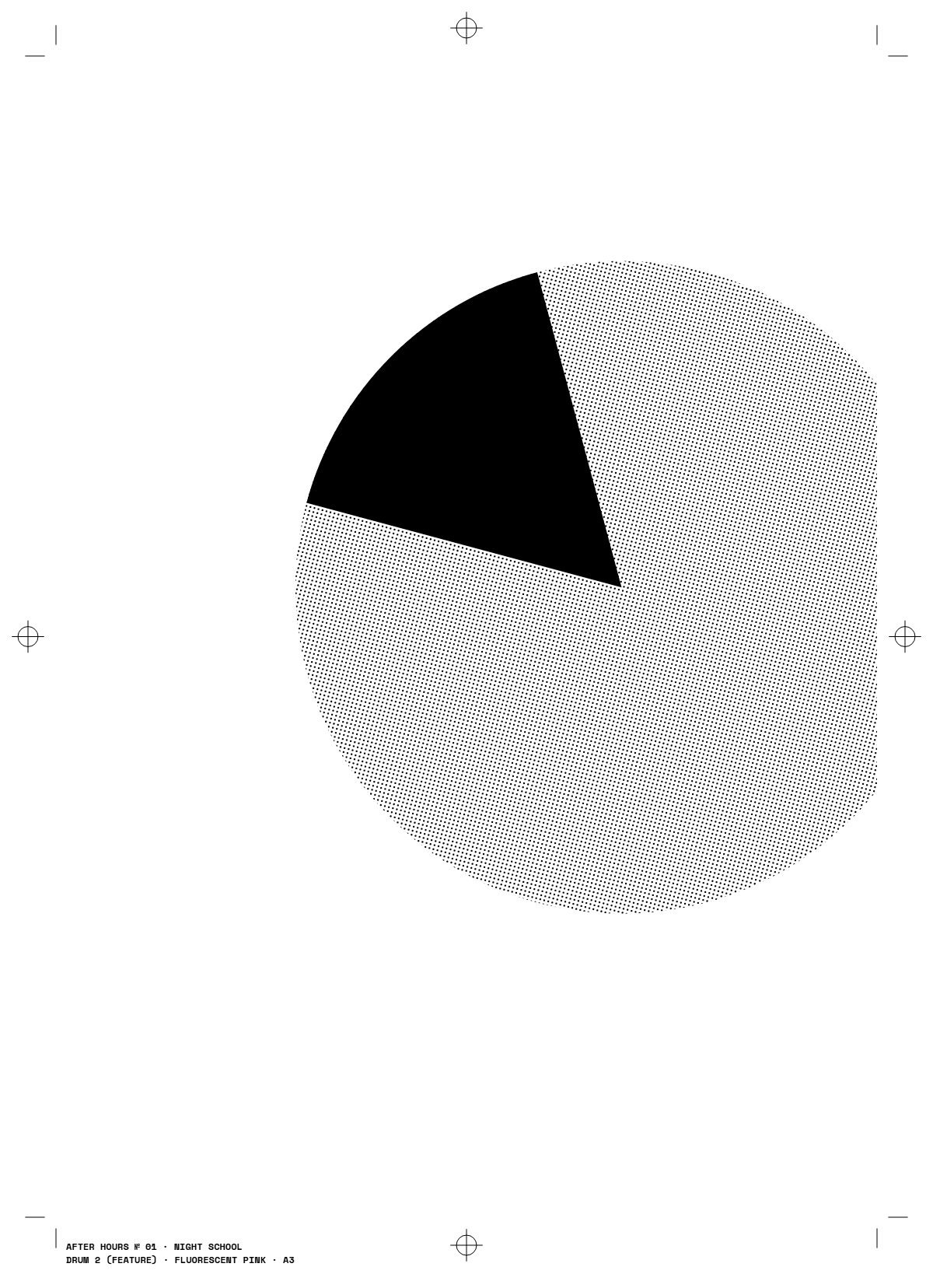
A risograph prints one ink per drum, from a black-and-white master. So the engine draws each ink as its own layer, with halftone screens instead of transparency, and then overprints the layers to preview. The masters below are real exports at 300 ppi with registration marks.

// Overprint the layers on paper, with a little misregistration on the feature ink.
function composite(canvas, ev, L, opt) {
  const o = Object.assign({ misreg: true, shift: 0 }, opt || {});
  const W = canvas.width, H = canvas.height, ctx = canvas.getContext("2d");
  const ro = roles(ev), paper = (PAPERS[ev.paper] || PAPERS.natural).hex;
  const R = rng(hash(ev.id + "misreg" + (ev.seed || 0)));
  const off = o.misreg ? [(R() - 0.5) * 1.6 * L.u + o.shift * L.u, (R() - 0.5) * 1.6 * L.u] : [0, 0];
  ctx.globalCompositeOperation = "source-over";
  ctx.fillStyle = paper; ctx.fillRect(0, 0, W, H);
  const tint = (layer, hex) => { const t = document.createElement("canvas"); t.width = W; t.height = H; const x = t.getContext("2d"); x.drawImage(layer, 0, 0); x.globalCompositeOperation = "source-in"; x.fillStyle = hex; x.fillRect(0, 0, W, H); return t; };
  ctx.globalCompositeOperation = "multiply";
  ctx.drawImage(tint(L.F, INKS[ro.feature].hex), off[0], off[1]);
  ctx.drawImage(tint(L.K, INKS[ro.key].hex), 0, 0);
  ctx.globalAlpha = 0.5;
  ctx.fillStyle = ctx.createPattern(grain(), "repeat");
  ctx.fillRect(0, 0, W, H);
  ctx.globalAlpha = 1;
  ctx.globalCompositeOperation = "source-over";
  return canvas;
}
05 / Every output
Wall, screen, listing, calendar.
The same event data makes all of them, so a change of time or room reaches every format at once.
The motion version, running live: the hand sweeps the night's hours, the second drum drifts.
Six-second loops recorded in the browser with MediaRecorder at 1080 px wide, for signage and feeds.
A full-colour PNG at 200 ppi for digital print, and one 300 ppi master per drum for the riso.
A public listings page grouped by month, with an .ics file for each night. Nights that run past midnight end on the right day.
Every poster on one sheet, for the printer, the press pack or the wall of the office.
06 / The season
Winter Lates, all eight.
Real exports from the studio. Select one to see it larger.
07 / Screens
The studio, captured from the app.
Select any screen to see it larger.
08 / Try it
The real studio, with the sample season.
This demo starts fresh each time; the full studio keeps your season in your browser.
- 1
Fix Static. Its pink key ink fails the 3:1 rule. Swap a drum and watch the check clear.
- 2
Add a night. New event drops it a week after the last; give it a title and pick a layout.
- 3
See the system. Open the Wall and turn on the guides.
Everything stays in your browser. Exports are PNG, WebM and .ics.
Open the full studio09 / How it's built
A poster engine first, an app around it.
core.js draws the posters, the masters and the calendar files and knows nothing about the page. The studio, this case study's poster maker and the motion loop all call the same functions.
- ~1,140lines of JavaScript and CSS
- 300ppi drum masters, one per ink
- 5layouts sharing one hierarchy
- 28overprint colours from 8 inks
- Layers as mastersEach ink is drawn black on clear. Tinting and multiplying makes the preview; the same layer, unchanged, is the master.
- Real halftonesTints are dot screens sized by area, so they survive being printed by a machine that can only put ink down or not.
- Type fitted, not setTitles are fitted to their zone with a binary search on size, line breaks recalculated at each step.
- The moon, calculatedPhase comes from the mean synodic month and a known new moon, accurate to within hours; the Moon layout draws the terminator.
- Colour checks that make senseSmall type is checked by luminance contrast; ink pairs by CIELAB ΔE, because two inks can be equally bright and still look nothing alike.
- Video in the browserThe motion loop is drawn to a canvas and recorded with captureStream and MediaRecorder, no server involved.
10 / What I'd test next
What a real print run would teach it.
The system works on screen and in its exports. A risograph and a real audience would test it properly.
Run a short edition: check halftone dot gain, how far the second drum really drifts, and whether the simulated colours match the real inks.
Test: one riso run of the seasonRisographs can't print to the edge. Shapes that run off the poster need 3 mm of bleed and an oversize sheet to trim.
Next: bleed on the mastersThe dial is a bet that a shape communicates "late" faster than a time. Ask passers-by what time each poster's event starts.
Test: five-second recall on the streetFive layouts across a season of eight works. A year of forty might need more modules, or rules for which layout each kind of night gets.
Test: a full year's programme